WattBot 2025 - RAG System for Technical Document Q&A
5th place solution for the WattBot 2025 Kaggle Competition - a Retrieval-Augmented Generation (RAG) system for answering technical questions from PDF documents.
Overview
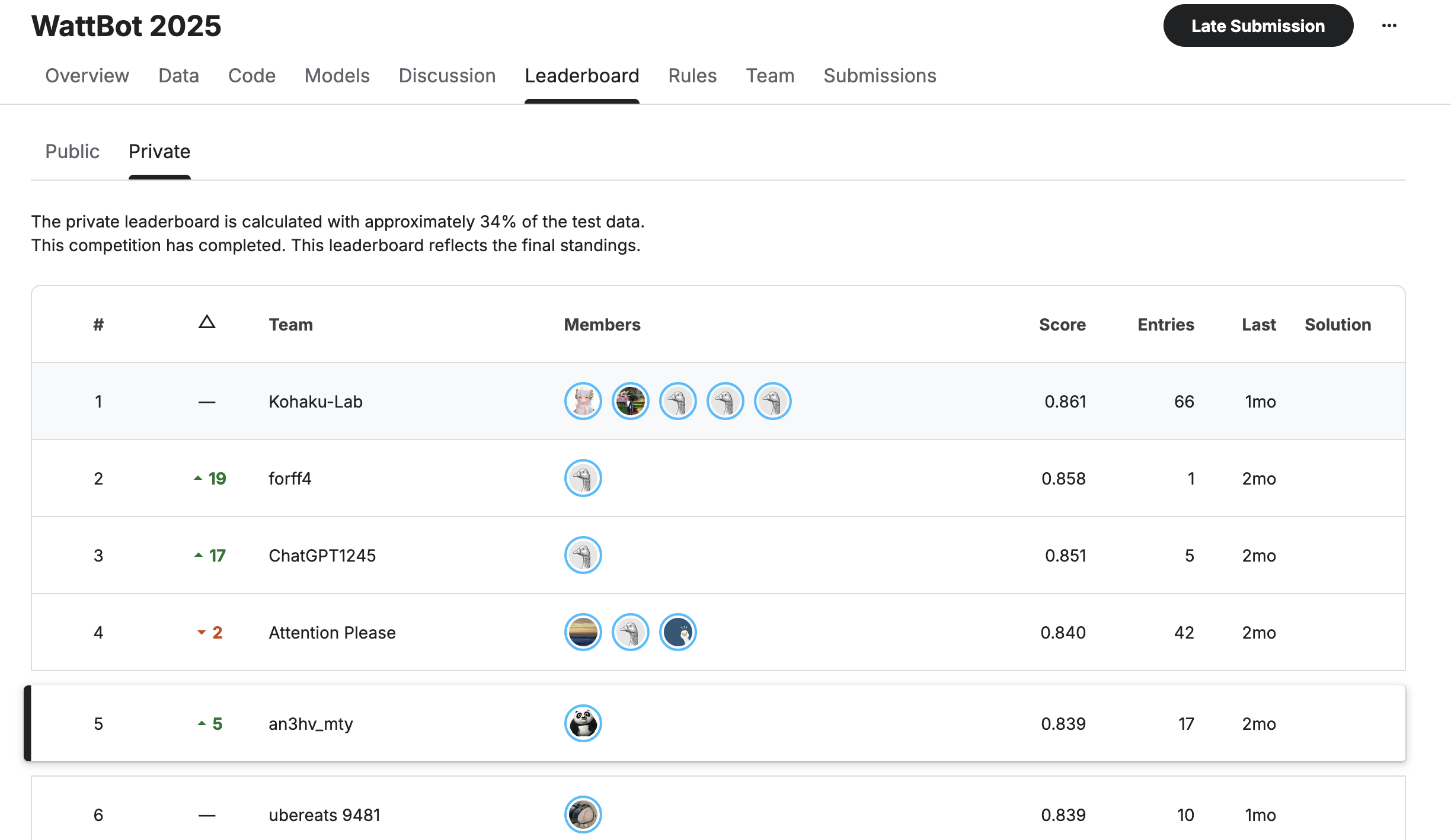
This project implements a RAG pipeline that achieved 5th place on the private leaderboard (10th on public) in the WattBot 2025 competition. The system extracts information from technical PDFs, chunks and indexes the content, retrieves relevant passages, and generates answers using open-source LLMs.
Key Features
- PDF Extraction: Extraction preserving layout, tables, and images using Datalab
- Hybrid Search: Combines lexical (BM25) and semantic search with reranking
- Multiple LLM Support: Integration with Fireworks AI models (DeepSeek v3.1, Kimi k2.5, GPT-OSS 20B)
- Evaluation Framework: Built-in evaluation using Braintrust platform with WattBot scoring metrics
- Sliding Window Chunking: Overlapping chunks maintain contextual continuity
- Neighbor Chunk Inclusion: Retrieves adjacent chunks for better context
Architecture
The pipeline consists of five main stages:
- PDF Extraction → Content with preserved structure
- Chunking → Sliding window approach with configurable overlap
- Indexing → BM25 lexical index + semantic embeddings (Qwen 8B)
- Retrieval → Hybrid search with Qwen 8B reranker
- Generation → JSON-formatted answers from open-source LLMs
Installation
Clone the repository
git clone https://github.com/anubhavmaity/wattbot.git
cd wattbot
Create and activate environment using uv
uv venv
source .venv/bin/activate
Install dependencies using pyproject.toml
uv pip install -e .Install nbdev if not already installed
uv pip install nbdevConfiguration
Key parameters to tune:
- PDF Extraction: There are various tools to extract content from PDF out there like docling, pypdf, datalab etc
- Chunk Size: Token/character count per chunk
- Overlap: Number of overlapping tokens between chunks
- Retrieval Count: Number of chunks to retrieve for lexical/semantic/hybrid
- Reranker Model: Qwen 8B, Cohere etc
- LLM Selection: Closed vs Open source models
- RRF Parameters: Weights, window size, k constant
Evaluation
The system uses the WattBot scoring metric:
WattBot Score = 0.75 × answer_value + 0.15 × ref_id + 0.10 × is_NA- answer_value (75%): Numeric answers within ±0.1% tolerance; exact categorical matches
- ref_id (15%): Jaccard overlap of reference IDs
- is_NA (10%): Correct identification of unanswerable questions
Run evaluations and logged in Braintrust platform for detailed analysis of chunking strategies, model performance, and retrieval methods.
Results
- Private Leaderboard: 5th place
- Public Leaderboard: 10th place
- Key Insights:
- Lexical search (BM25) perfomed better than semantic search
- Markdown extraction better than text-only extraction
- Hybrid search with reranking provided best results
- Neighbor chunk increased accuracy
- Proprietary models (OpenAI) showed improvements but exceeded budget
Technical Highlights
PDF Extraction
- Used
pypdffor text extraction from PDF - Used Datalab for markdown extraction. Preserves layout, tables, and images better than
pypdforDocling.
Search Strategy
Started with BM25 lexical search. Added Qwen 8B embeddings for semantic search. Combined both with reranking model for optimal retrieval.
Prompting
- Markdown-formatted prompts work best with open-source models
- Explicit instructions preferred over assumptions
- JSON output format for easy parsing
- Tested zero-shot, few-shot, and chain-of-thought approaches
Chunking
- Character/Token based chunking with overlap
- Markdown chunking with sliding window overlap maintained context across chunk boundaries.
Project Structure
Built with nbdev for literate programming approach.
Lessons Learned
- Start with lexical search before jumping to vector embeddings
- PDF extraction quality matters more than retrieval sophistication
- Evaluation infrastructure is critical for iterative improvement
- Prompt engineering is artisanal and requires iteration
- Open-source models can achieve competitive results with proper tuning
Acknowledgments
Built using Solveit for development workflow. Solveit dialogues: Exploration and SDK
Competition organized by Christopher Endemann, Dhruba Jyoti Paul, and Annie Zhao on Kaggle: WattBot 2025